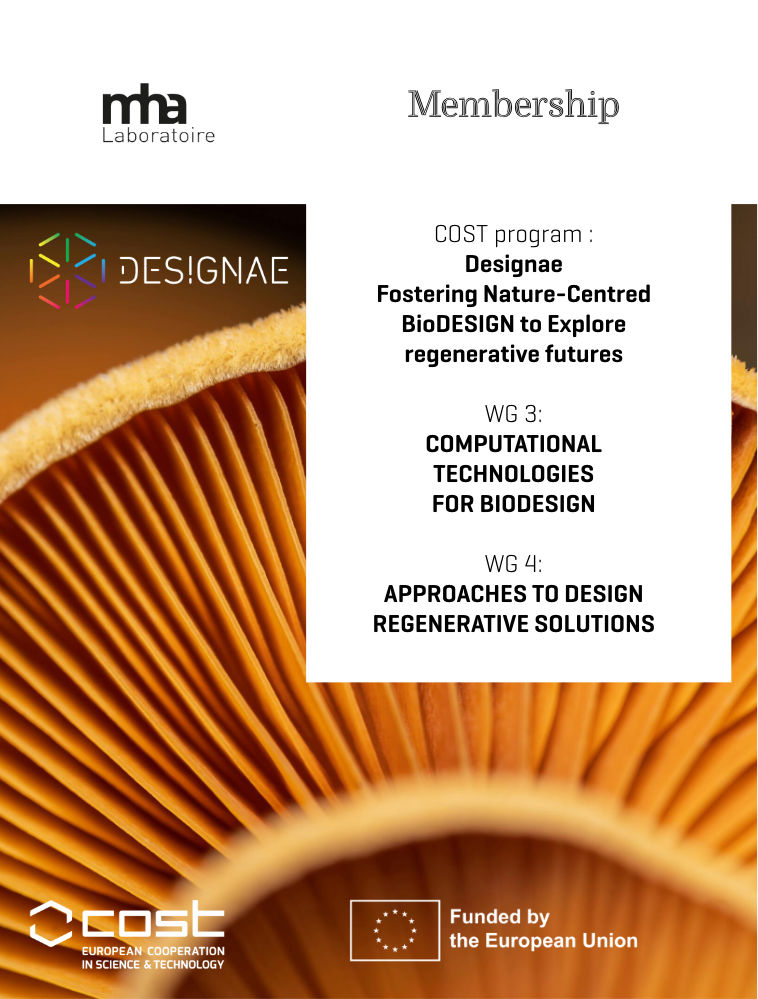
Les membres du laboratoire sont membre du projet Designae (Fostering Nature-Centred BioDESIGN to Explore regenerative futures) soutenu par la commission européenne dans le cadre du programme COST (European and Collaboration in Science and Technology).
Le laboratoire est membre des groupes de travail :
WG 3: COMPUTATIONAL TECHNOLOGIES FOR BIODESIGN :
WG3 focuses on exploring the application of Computational Technologies to develop biodesign solutions, involving as needed Artificial Intelligence (AI) and Computer Aided Design. This WG will explore how natural systems can assist in the development of AI-based solution finding and decision making (e.g. slime molds, movement patterns of diatoms and other protists, etc) and investigate how scaling capabilities can be enhanced with focus on biological structures and nature based solutions, enhancing predictive models.
Tasks :
- Methods and application areas in computation: Map existing application areas and identify potential future connection points with other relevant fields.
- Computational technologies for biodesign: Test available Computational Technologies’ potential to translate biological structures into design and develop case studies in biodesign for regeneration and restoration.
- AI integration in computation for biodesign: Explore potential new applications of AI to enhance biodesign processes, for a more effective integration in workflows.
- Challenges and Limitations: Identify and analyse current limitations and challenges in applying computational technologies to biodesign. Explore potential solutions and workarounds for identified challenges, and develop recommendations for overcoming these limitations in future research and applications.
WG 4: APPROACHES TO DESIGN REGENERATIVE SOLUTIONS :
WG4 synthesises insights from WG1-3 to develop an interdisciplinary approach for nature-centred biodesign solutions. It focuses on refining methods for collaboration, using biological systems, technologies, and design principles to create regenerative, sustainable biodesign solutions. WG4 aims to bridge theory and practice by engaging with industries like architecture, healthcare, and frontier technology applications, fostering innovation. It will address existing challenges and future possibilities to drive transformative biodesign solutions.
Tasks :
- Foster interdisciplinary practice, methods and approaches: Test, validate and/or improve interdisciplinary practices, methods and approaches identified in literature and in biodesign projects (WG1).
- Stakeholder engagement and challenge identification: Identify potential industry, NGO partnerships across ITCs and non-ITCs; conduct needs assessment to identify real- world challenges suitable for biodesign innovation; list challenges and opportunities for applications.
- Biodesign development and prototyping: Develop and prototype biodesign solutions for regeneration while considering inputs from WG1-3.
- Frontier exploration and Generative AI in biodesign: Explore and push the boundaries of biodesign to address emerging challenges and opportunities in new and frontier areas, generate.